
SIRS & Incidents
From incident to evidence — with every deadline tracked.
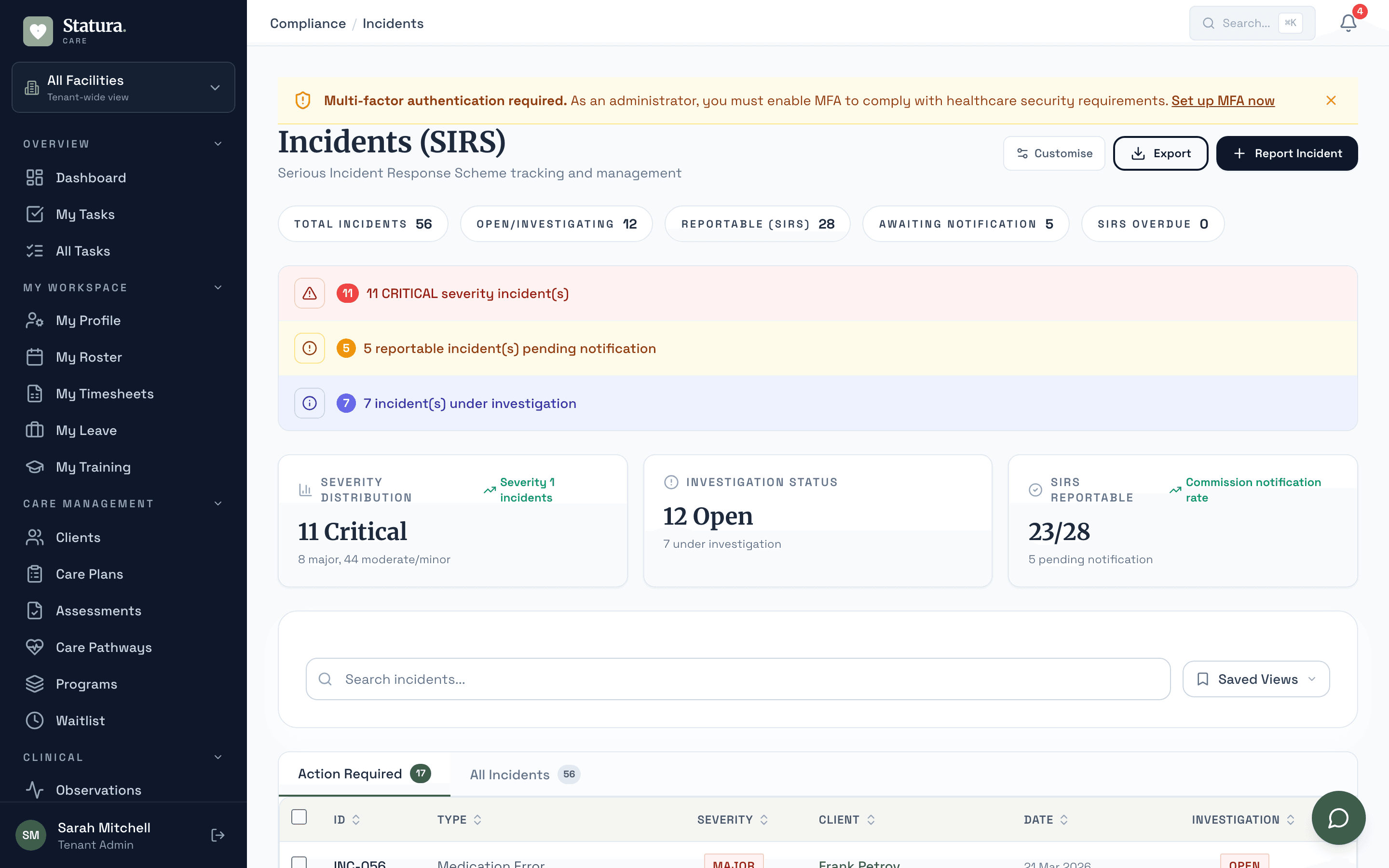
The Serious Incident Response Scheme (SIRS) requires providers to report serious incidents to the ACQSC within strict timeframes — 24 hours for Priority 1, 30 days for Priority 2. Statura Care’s SIRS module automates deadline tracking, structures the investigation process, and maintains the restrictive practices register and behaviour support plans in one integrated system.
The Challenge
Missing a Priority 1 SIRS notification deadline can trigger immediate regulatory intervention. Managing incidents across spreadsheets, emails, and paper forms creates unacceptable risk — especially when you need to track investigations, remediation actions, and restrictive practices simultaneously.
Key Capabilities
What the SIRS & Incidents module does.
Incident Register with Guided Classification
Report incidents across 8 types defined in the Act: unreasonable use of force, unlawful sexual contact or inappropriate sexual conduct, psychological or emotional abuse, unexpected death, stealing or financial coercion, neglect, inappropriate use of restrictive practices, and unexplained absence from care. Priority is suggested from the recorded outcome and flagged for review.
Deadline Countdown & Escalation
Priority 1 incidents trigger a 24-hour countdown with critical alerts at 20 hours. Priority 2 incidents have a 30-day deadline with escalating alerts at 14, 25, and 28 days.
ACQSC Notification Management
Generate initial notification and final report packs with incident details pre-populated for review, approval, and portal submission - with full audit trail.
Investigation Workflow
Assign investigators, track investigation status, record findings, identify root causes, and document recommendations. Every step is logged for regulatory review.
Priority 1 Override
Compliance officers can escalate any incident to Priority 1 with a single action - immediately triggering the 24-hour countdown, critical alerts, and ACQSC notification workflow regardless of the initial suggested classification.
Restrictive Practices Register
Comprehensive register covering chemical, physical, mechanical, and environmental restraint and seclusion. Each use records authorisation, duration, clinical rationale, consent status, and behaviour support plan linkage. Tracks trends to identify reduction opportunities.
Behaviour Support Plans
Full behaviour support planning with antecedent-behaviour-consequence documentation, positive strategies trialled, approved restrictive practices, consent tracking, and scheduled review dates. Plans are linked to the restrictive practices register so every use is validated against an approved plan.
Live Compliance View
How SIRS & Incidents strengthens the live compliance picture.
Statura modules are modular for adoption, but connected for visibility. Work captured in this module can update the wider view of risk, evidence, deadlines and governance without a separate reporting exercise.
Captured at the source
SIRS & Incidents activity becomes part of the shared operating record instead of sitting in a disconnected module.
Exceptions surface earlier
Deadlines, overdue actions, missing evidence and operational risk can be seen while there is still time to act.
Evidence stays current
Registers, reports and audit trails are strengthened by the work teams already complete each day.
The compliance view updates
Every connected workflow adds signal to the live compliance picture executives, managers and quality teams rely on.
How It Works
The SIRS & Incidents workflow.
Incident Reported
A staff member reports a serious incident. The system suggests the priority for review and calculates the ACQSC notification deadline.
Deadline Countdown
For P1, a 24-hour countdown begins with escalating alerts to compliance officers, managers, and the responsible person on duty.
ACQSC Notification
The notification pack is generated with incident details. Review, approve, and upload through the provider portal with full audit trail.
Investigation Launched
An investigator is assigned. Findings, root causes, and recommendations are documented systematically.
Remediation Tracked
Investigation recommendations become tracked actions with owners, due dates, and completion evidence.
Regulatory Requirements
What the law requires.
The Aged Care Act 2024 (s 164) sets specific obligations that this module helps you meet systematically.
P1: 24-Hour Notification
Priority 1 incidents — those that have caused or could reasonably be expected to cause injury requiring medical or psychological treatment, involve unlawful sexual contact, or where there are reasonable grounds for reporting to police — must be notified to the ACQSC within 24 hours.
P2: 30-Day Notification
Priority 2 incidents must be notified within 30 calendar days.
Final Report: 84 Days (If Required)
A final report is not automatic for every incident. Where the Commissioner requires one, it must be given within 84 days of the initial notification — or another period the Commissioner specifies (Aged Care Rules 2025, s 165A-45).
Investigation Required
All serious incidents must be investigated with findings documented.
See SIRS & Incidents in the platform.
Book a walkthrough and we’ll show you SIRS & Incidents working against your own workflows.
Works With
Better together.
When modules work together, intelligence compounds. SIRS & Incidents integrates with these modules for a complete compliance picture.
FAQ
Frequently asked questions
What are the reportable incident types under SIRS?
The Act defines 8 types: unreasonable use of force, unlawful sexual contact or inappropriate sexual conduct, psychological or emotional abuse, unexpected death, stealing or financial coercion, neglect, inappropriate use of restrictive practices, and unexplained absence from care.
What are the SIRS notification deadlines?
Priority 1 incidents — those that have caused or could reasonably be expected to cause injury requiring medical or psychological treatment, involve unlawful sexual contact, or where there are reasonable grounds for reporting to police — must be notified to the ACQSC within 24 hours. Priority 2 incidents must be notified within 30 calendar days (not business days). A final report is not required for every incident — where the Commissioner requires one, it must be given within 84 days of the initial notification, or another period the Commissioner specifies (Aged Care Rules 2025, s 165A-45).
How does the module handle restrictive practices?
The module maintains a restrictive practices register covering chemical, physical, mechanical, and environmental restraint and seclusion. Each use must be authorised, time-limited, and linked to an assessed behaviour support plan with alternative strategies documented.
Can the system classify incident priority?
Yes. When an incident is reported, the system suggests the priority based on severity criteria, flags it for review, and immediately calculates the ACQSC notification deadline. Priority 1 incidents trigger a 24-hour countdown with critical alerts to compliance officers, managers, and the responsible person on duty.
See SIRS & Incidents in action.
Request a personalised demo of the SIRS & Incidents module tailored to your organisation.
Free trial available on Compliance Essentials (12 modules). No credit card required.
Want the lowest-commitment starting point? Start Compliance Essentials free trial →
Not sure where to start first? Take our free compliance assessment →